

Faeries on Fire
Travis Alabanza employs the chaotic and the spectacular to remind us that we cannot afford performance art as entertainment alone.

Travis Alabanza is an arsonist. Whatever they do, whichever space they’re in, they wield their pen as flamethrower, setting pages, stages and hearts alight. Their role as arsonist, though, is not one of wanton destruction, but destruction with a noble cause: the illumination of art as a creative and political act. The Royal Court Theatre is the latest stage to be so ennobled by Travis. Sound of the Underground, co-created with Debbie Hannan, is a captivating homage to the queer nightlife that shaped Travis into the stage-blazing dynamo they have become, and it issues an urgent warning about the consequences of LGBTQ assimilation into the dominant and ravaging order of our time.
There is much to praise about Sound of the Underground. The acting and performances of CHIYO, Lilly SnatchDragon, Ms Sharon Le Grand, Mwice Kavindele (as Sadie Sinner the Songbird), Rhys Hollis (as Rhys’ Pieces), Sue Gives A Fuck, Tammy Reynolds (as Midgitte Bardot) and Wet Mess do nothing less than activate and enliven the audience—and each performer deserves close study. One by one, they offer their masterclass; all together, they evidence the ensorceling power of creatives rallied around a collective cause. In doing so, they honour the hallowed stage of the Royal Court, whose plays are performed on stage and taught in classrooms across the globe.
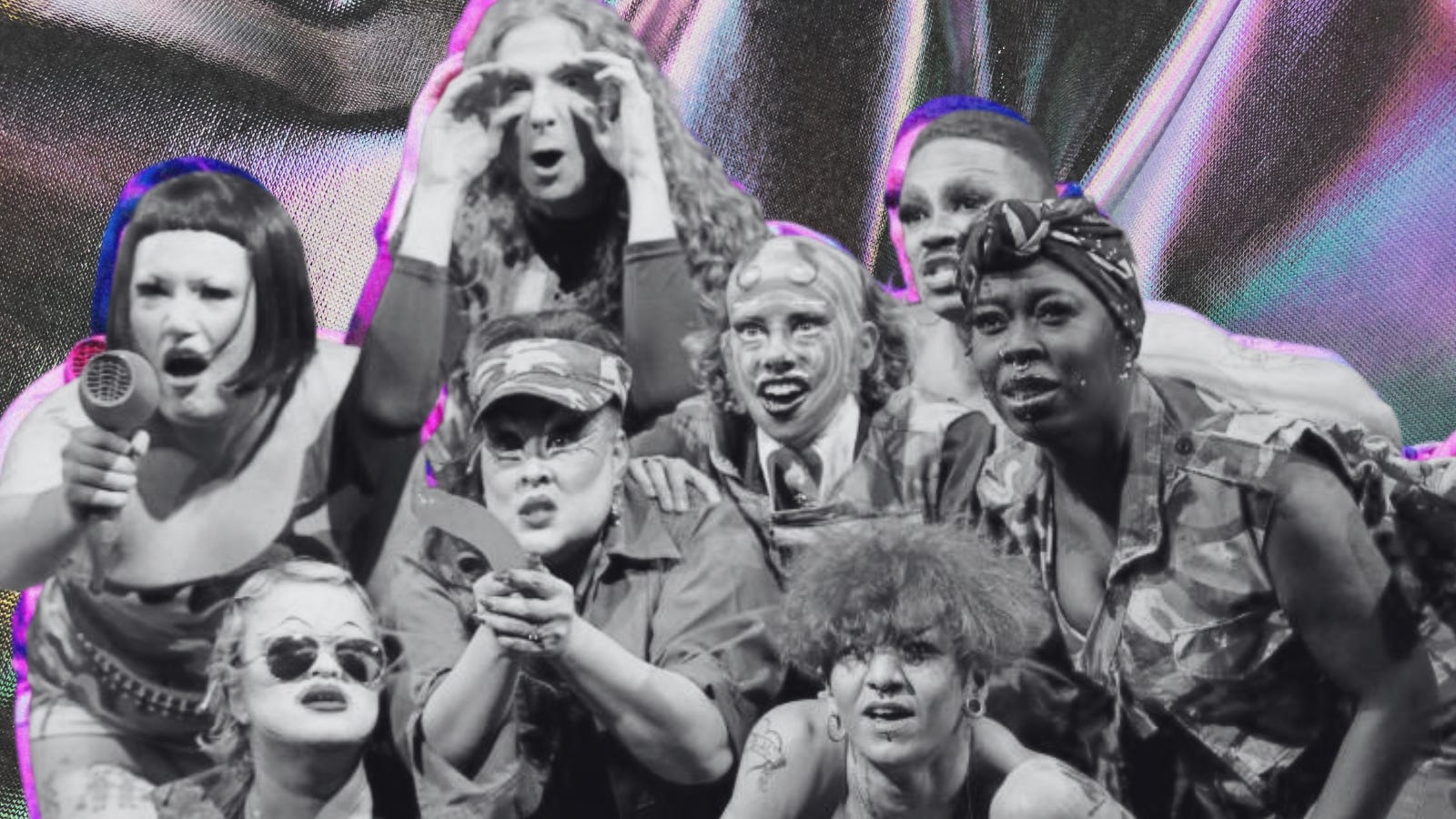
There is, as always, the comedy, cheek and sass of it all—each elemental in anything fortunate enough to have Travis’ name emblazoned upon it. But the most praiseworthy offering from Sound of the Underground is how it develops, delivers and detonates its incisive critique of the price underground queer performers have been forced to pay for “our” “inclusion”. Sound of the Underground utilises RuPaul’s Drag Race to challenge the commodification of drag performance, showing how the mainstreaming of an important and life-giving art form has helped sustain the dispossession and displacement of vulnerable LGBTQ communities and venues in the so-called West.
A legacy of single-issue gay politics, RuPaul’s Drag Race is an appropriate vehicle for this critique. In the sanitising and keening effort to enshrine gay marriage rights, LGBTQ people of colour, trans people, sex workers and the homeless (among many others)—and the issues that truly impacted their lives—were jettisoned to make gay marriage more palatable. It worked, and while wealthy white gays and lesbians celebrated their economic equality with their heterosexual comrades, those who were left behind have stayed behind, save for the select anointing of a few to celebrity-level visibility. Sound of the Underground pays tribute to the abandoned: namely, the artists, performers and creatives who continue to challenge the consumptive and tokenising thrust of mainstream LGBTQ assimilation.
Gay marriage is an enduring heuristic for the pitfalls of single-issue politics: we know that visibility and representation on their own are not enough, that juridical protections for some certainly don’t ensure safety for all, and that inclusion of a few comes at a great cost to many—a cost borne, over again and always, by those resisting the normative demands of the generation attempting to indoctrinate them. By platforming the performers and art forms impacted by the historical, political and emotional ramifications of our commodification, Sound of the Underground asks the audience an important question: Can we be honest enough to see ourselves implicated in the cannibalism?
The play does what Toni Morrison said art should do, but art itself cannot intervene in the violence our communities face: it can only attempt to encourage its interruption. Whether glass-encased paintings are “defaced” or young people tie themselves to planes, art is only as provocative as the action it inspires. I’m not sure Travis intends to be provocative; they just tell the truth, and if that is confronting for any of us, then we should be so engulfed in their flames. Travis corrals and deploys the chaotic and the spectacular to remind us what’s at stake: we cannot afford performance as entertainment alone. After all, art without conscience or consequence is merely spectacle.
My review of Travis Alabanza’s play, Sound of the Underground, was originally published in 2023 on the now-shuttered AZ Mag, one of the UK’s few and only digital media platforms centring LGBTQ POC.
Supporting Black LGBTQ media makers and culture workers to surface and celebrate our stories, in ways that are nuanced and expansive, is especially important in imperial outposts like England, where the means, opportunities and resources for Black storytelling (broadly) are a fraction of what is made available to others.
The Dancing Boy is one of the ways I’m attempting to fund the reverential work of Busy Being Black, as I aspire to and believe in the Queer Archivist Code of Ethics.
If you can afford to, consider upgrading your subscription or give an encouragement.